Disease & Condition Directory
Eagle Syndrome
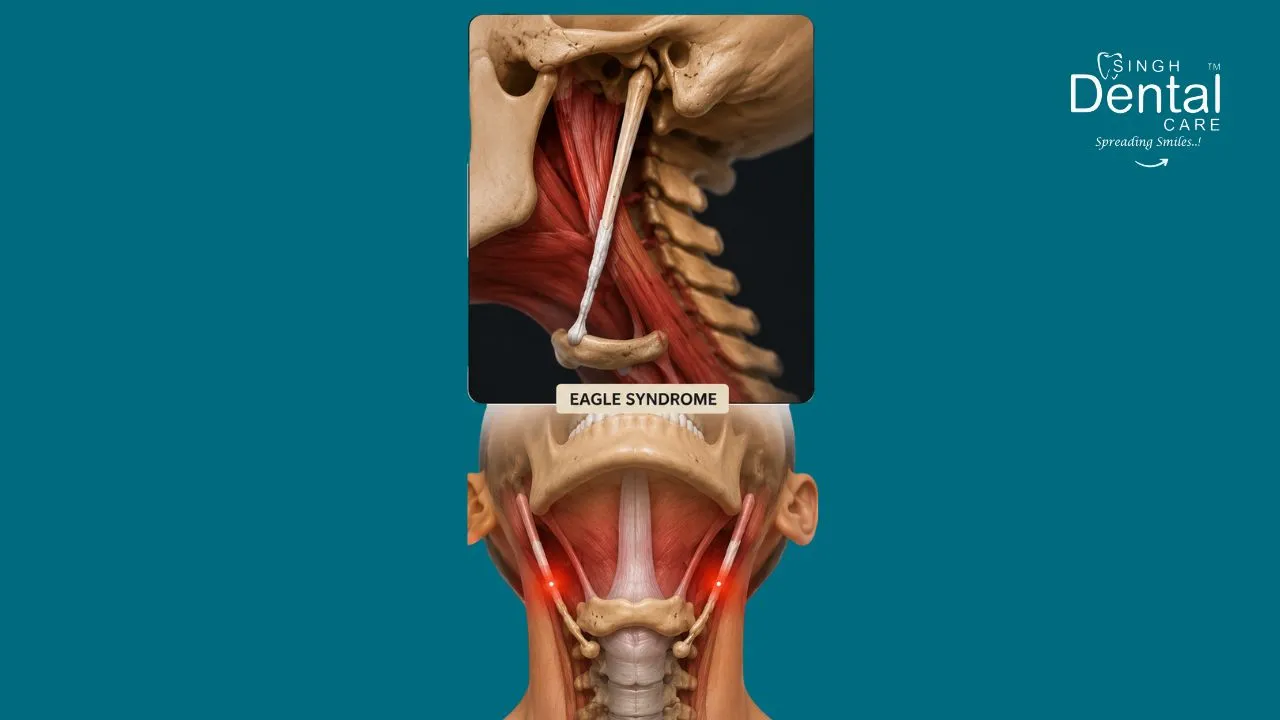
Eagle Syndrome
Understanding Eagle Syndrome
What Is Eagle Syndrome?
Eagle Syndrome is a rare condition caused by an elongated styloid process (a thin, pointed bone located just below the ear) or by calcification (hardening) of the stylohyoid ligament. When these structures become unusually long or calcified, they can irritate nearby nerves and blood vessels, leading to pain and discomfort in the throat, face, jaw, neck, or ear.
Many people have an elongated styloid process without symptoms. Eagle Syndrome is diagnosed only when the elongated styloid process or calcified ligament causes clinical symptoms.
At Singh Dental Care, we perform a thorough clinical evaluation and advanced imaging to diagnose Eagle Syndrome and coordinate appropriate treatment with oral and maxillofacial surgeons or ENT specialists when required.
Signs and Symptoms
Symptoms of Eagle Syndrome may develop gradually and often affect one side of the face, although both sides can be involved.
Common signs and symptoms include:
Persistent pain in the throat
Pain near the angle of the jaw
Ear pain without an ear infection
Pain while swallowing (Odynophagia)
Difficulty swallowing (Dysphagia)
Sensation of something stuck in the throat (Foreign body sensation)
Facial pain
Neck pain
Pain that worsens when turning the head
Headaches
Pain while yawning
Pain during chewing
Voice discomfort in some patients
Causes of Eagle Syndrome
Elongated Styloid Process :- The styloid process grows longer than normal and presses against nearby tissues.
Calcification of the Stylohyoid Ligament :- The normally flexible ligament becomes hardened and less mobile.
Previous Trauma :- In some cases, injury to the neck or throat may contribute to symptom development.
Previous Tonsil Surgery :- Some patients develop symptoms after tonsillectomy, although this association is uncommon.
Age-Related Changes :- Calcification of ligaments may occur gradually with age.
Risk Factors
Have an elongated styloid process
Have calcification of the stylohyoid ligament
Are over 30 years of age
Have a history of throat or neck trauma
Have undergone tonsillectomy
Are female (reported more commonly than in males)
Types of Eagle Syndrome -
>Classic Eagle Syndrome
Usually caused by irritation of nearby nerves due to an elongated styloid process.
Common symptoms include:
Throat pain
Ear pain
Difficulty swallowing
Foreign body sensation
Pain while turning the head
>Vascular Eagle Syndrome
Occurs when the elongated styloid process compresses nearby blood vessels, particularly the carotid artery.
Possible symptoms include:
Neck pain
Headache
Dizziness
Temporary visual disturbances
Rarely, symptoms related to reduced blood flow
This form requires prompt specialist evaluation because vascular compression can occasionally lead to serious complications.
What Happens If Eagle Syndrome Is Left Untreated?
Untreated Eagle Syndrome may lead to:
Persistent facial and throat pain
Chronic difficulty swallowing
Reduced quality of life
Difficulty eating comfortably
Recurrent neck discomfort
Persistent headaches
Ongoing nerve irritation
Rare vascular complications in patients with vascular Eagle Syndrome
Early diagnosis helps relieve symptoms and prevent unnecessary treatments.
Diagnosis at Singh Dental Care :- Our dental team evaluates Eagle Syndrome through:
Clinical Examination :- Assessment of pain location, jaw movement, swallowing, and tenderness around the throat and jaw.
Medical History :- Review of symptoms, previous throat surgery, trauma, and pain characteristics.
Intraoral Examination :- Careful examination of the tonsillar region where the styloid process may occasionally be palpable.
Digital Panoramic X-Ray (OPG) :- May reveal an elongated styloid process or calcified stylohyoid ligament.
Cone Beam CT (CBCT) or CT Scan :- Provides detailed three-dimensional imaging and is often the preferred method for confirming the diagnosis and surgical planning.
Treatment Options :- Treatment depends on the severity of symptoms.
Observation :- Patients with mild symptoms may only require monitoring.
Pain Medications :- Anti-inflammatory medications or pain relievers may help reduce discomfort.
Muscle Relaxants :- May be prescribed when muscle tension contributes to symptoms.
Local Anesthetic or Steroid Injections :- Selected patients may benefit from injections around the affected area to relieve pain.
Physiotherapy :- Gentle neck exercises and posture correction may provide additional symptom relief.
Surgical Treatment (Styloidectomy) :- For persistent or severe symptoms, surgical shortening or removal of the elongated styloid process (styloidectomy) may be recommended. This procedure may be performed through:
An intraoral (inside the mouth) approach
An external (neck) approach
The choice of technique depends on the patient's anatomy and the surgeon's recommendation.
Prevention Tips
Since Eagle Syndrome is usually related to anatomical variation, it cannot always be prevented. However, you can help maintain oral and neck health by:
Seeking evaluation for persistent throat or facial pain
Avoiding self-diagnosis of chronic jaw pain
Treating TMJ disorders when present
Maintaining good posture
Attending regular dental examinations
Following up promptly after facial or neck injuries
Early diagnosis helps prevent prolonged discomfort and unnecessary treatment.
FAQ
Q)Is Eagle Syndrome common?
A)No. Eagle Syndrome is a relatively rare condition. Many people have an elongated styloid process without experiencing any symptoms.
Q)Can Eagle Syndrome be mistaken for TMJ disorder?
A)Yes. Because both conditions can cause jaw, ear, and facial pain, Eagle Syndrome is sometimes mistaken for TMJ disorders, dental pain, or throat infections.
Q)Does everyone with an elongated styloid process need treatment?
A)No. Treatment is only necessary if the elongated styloid process causes symptoms.
Q)Can Eagle Syndrome cause difficulty swallowing?
A)Yes. Pain or difficulty while swallowing is one of the most common symptoms.
Q)How is Eagle Syndrome diagnosed?
A)Diagnosis is based on a combination of clinical examination, medical history, and imaging studies such as panoramic X-rays, CBCT, or CT scans.
Q)Is surgery always required?
A)No. Many patients experience relief with conservative treatment. Surgery is reserved for patients with persistent symptoms or significant anatomical compression
Dr. Bikramjeet Singh
BDS & Fellowship in ImplantologyChief Dental Surgeon & Implantologist • Singh Dental Care
This clinical condition overview has been authored and verified by dental specialists at Singh Dental Care to ensure evidence-based, safe, and accurate oral healthcare guidance.
Seek Professional Advice
Our specialists at Singh Dental Care are equipped with advanced technology to diagnose and treat eagle syndrome with precision.
Disclaimer: The information provided above is for educational purposes only and should not be considered as medical advice. Please consult with a qualified dental professional for diagnosis and treatment options.